
How to Promote Theater, Dance, and Performing Arts Events Online
Live arts organizations are operating in a dramatically different landscape than they were even five years ago.
A patron no longer flips through a mailed season brochure and circles dates on a calendar. Instead, they sit on their couch scrolling through their phone. Within seconds, they can compare your upcoming production to a Netflix premiere, a touring Broadway show, a comedy special, or a viral performance clip on TikTok.
The competition isn’t just the theater across town anymore. It’s the endless convenience of digital entertainment.
At the same time, arts organizations are navigating shrinking funding, rising production costs, and shifting audience behaviors. Younger audiences expect instant information. Older patrons expect seamless digital ticketing. Everyone expects speed, clarity, and ease.
In this environment, your website cannot simply list performances. It must actively persuade. It must build anticipation. It must make attending feel effortless and urgent.
Your website is no longer a digital playbill.
It is your most important ticket-selling engine.
If your performing arts event promotion strategy isn’t intentionally built around audience behavior, search visibility, and conversion strategy, even a remarkable production can struggle to fill seats.
The good news? With the right structure, your website can become the most powerful stage you have, working for you 24/7, long before opening night.
Start With Audience Behavior, Not Website Design
Before redesigning pages or rewriting copy, start with behavior.
Because the truth is, your audience has already changed, whether your website has or not.
Picture this: it’s Thursday evening. Someone is sitting on their couch scrolling through their phone. They type “things to do this weekend” into Google. Within seconds, they see a mix of concerts, comedy shows, festivals, and live theater, all competing for attention in the same results feed.
They are not deeply researching. They are scanning.
Today’s performing arts patrons:
- Search on mobile first
- Look for immediate, local entertainment options
- Compare multiple venues in minutes
- Expect instant access to ticket pricing and availability
- Make impulse buying decisions if the experience feels exciting and easy
If your website requires too many clicks, hides key details, or loads slowly, they won’t wait. They’ll simply choose another option.
At the same time, not all audiences behave the same way.
- A single-ticket buyer may be spontaneous, responding to a compelling headline or a friend’s recommendation.
- A season subscriber may want to compare packages, evaluate dates, and review seating options before committing.
- Donors and members often look for deeper alignment with mission, impact, and community value.
- Younger first-time attendees may be evaluating not just the show, but whether your venue feels welcoming, modern, and culturally relevant.
- A successful performing arts marketing strategy acknowledges these differences. It aligns your website experience with how these audiences actually behave, not how we hope they do.
When your digital experience reflects real audience behavior, ticket buying feels natural instead of forced. And that is where conversion begins.
If you’d like, I can make this even sharper and slightly more executive in tone, or soften it a bit more to be more nonprofit-friendly.
User-Experience: Remove Friction
The first reason to vigorously promote events on your website is the significant amount of time we spend online. This is especially true for younger audiences. Additionally, advanced technologies have led to increasingly high audience expectations and demands. This all adds up to making your website’s user experience a top priority.
In essence, user experience is the level of satisfaction users experience when interacting with a website. The primary aim of UX is to create an experience that helps users achieve their goals efficiently and establishes a positive impression of the brand.
Your Website Must Be Effortless
Here are seven crucial UX factors:
Factors leading to a positive user experience:
- Clear, well-structured content
- Simple navigation and layout
- Effective design for performing arts organizations
- Best look and feel for your arts organization
- Speed
- Intuitive navigation and functionality
- Easy-to-complete forms
- Mobile-friendly design
What happens if your website lacks these factors? The answer is clear. They will look elsewhere for an event. Not only do you lose a sale for a particular performance, but you might lose them for good.
Build your reputation while promoting upcoming events on your website
Another key issue for promoting events online is how your digital presence affects your reputation. After all, a positive reputation impacts ticket sales, audience loyalty, and resilience in a competitive field. The fact is that it’s hard to control public opinion. For example, social media channels may contradict your message or provide incorrect facts. Mentions of your performances will also be short-lived as readers quickly scroll through an ever-changing newsfeed.
On the other hand, you have total control over your website, making it an asset that can reinforce your online reputation. You choose how to present yourself and promote upcoming performances. Plus, unlike social channels, your website is “always on.”
Know your audience to form a connection
Above all, the most important factor when building your website is understanding your audience and their website behaviors. As you promote events on your website, knowing your audience will be the foundation of your strategy. You will apply it to all aspects of your site, including tone, content, functionality, and graphic design. By tailoring your site to user needs, you increase trust, engagement, and conversion.
Briefly, your audience must be your central consideration when creating your website. If you fail to connect with your audience, the results will be high bounce rates, low conversion, and missed opportunities.
Now that we understand the basics, it’s time to talk about specific tactics.
Create Dedicated Performance Pages That Sell the Experience
Too many performing arts websites treat event listings like a calendar entry.
Date. Time. Short description. Buy button.
But live performance isn’t a calendar event. It’s an experience.
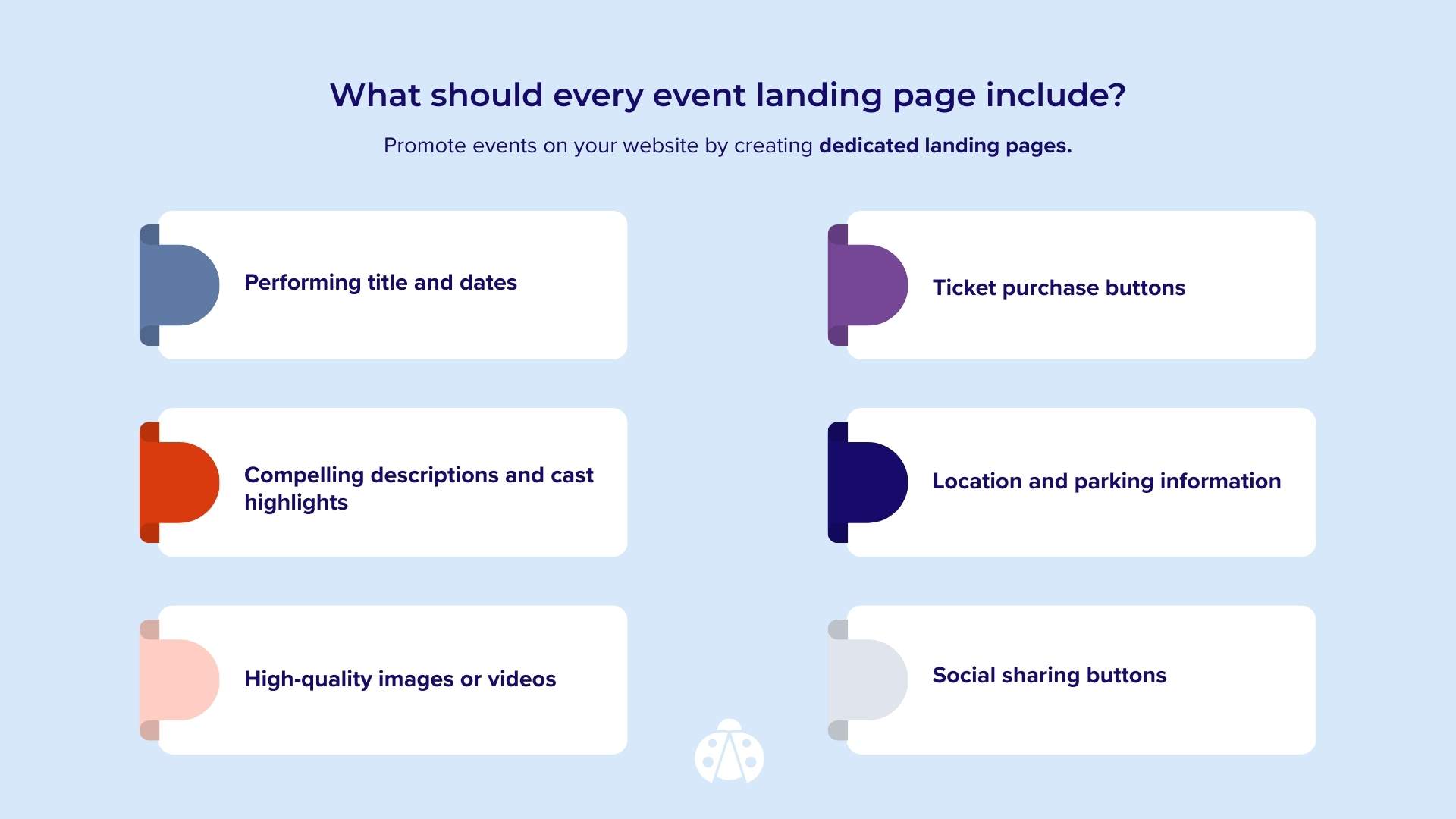
Each production deserves its own optimized landing page — built not just to inform, but to persuade.
When someone clicks on a performance, they’re asking a quiet question: Is this worth my time?
Your page should answer that immediately.
A strong performing arts event page includes:
- A compelling description that communicates emotional impact
- Clear dates and performance times
- Cast, director, or company credibility
- High-quality imagery or short video clips
- Prominent, consistent “Buy Tickets” calls-to-action
- Essential logistics like location, parking, and accessibility
But beyond structure, the page should build anticipation.
- What makes this show different?
- Is it a limited run?
- Is it part of a larger season theme?
Is there a reason to act now?
Scarcity is inherent in live performance. Once the curtain closes, the opportunity is gone. When you communicate that clearly, urgency becomes natural rather than pushy.
From an SEO standpoint, dedicated event pages also increase visibility. Each production becomes a searchable asset for terms like:
- “Theater in [City] this weekend.”
- “[Show Name] tickets”
- “Live dance performance near me”
When optimized properly, these pages don’t just support your marketing efforts; they extend them.
Use SEO to Capture Local Event Searches
Use proven SEO (Search Engine Optimization) techniques that make your website pages easier for both users and search engines to find and understand. SEO-optimization will increase visibility, drive higher-quality traffic, and reach more customers searching for local entertainment.
SEO tips include:
- Performing keyword research to identify and analyze potential search terms
- Aligning content with user intent for improved organic rankings and conversion
- Using keyword terms naturally in page titles, headings, meta descriptions and image alt text
- Including location keywords, such as your city and venue name, to improve local visibility
- Using internal links to the event’s landing page from your homepage and blog posts
Promote events on your website to drive conversions.
Increasing visibility and attracting people to your website is the first measure of success. Clearly, though, that’s not enough when promoting events on your website. Visitors must convert to make it count. Effective CTAs (calls to action) are essential for conversion.
CTA buttons, icons, animations, or other CTA elements should be:
- Clear and concise
- Highly visible (on the home pages and above the fold)
- Action-oriented (Buy Tickets Now, Reserve Your Seat)
- Visually stands out
- Mobile-friendly
Engaging content is essential for successful event website promotion.
Develop high-quality content that builds excitement among loyal patrons, potential attendees, donors, partners, and other community members. High-quality content captures visitors’ attention and keeps them on the site longer, improves SEO rankings, and drives conversions.
Ideas include:
- Performer interviews
- Cast/crew interviews
- Rehearsal videos
- Set and costume previews
- Artist and director stories
Not only do these pieces improve SEO, but they also foster a deeper connection with your venue and upcoming productions. Other benefits include building trust, demonstrating credibility, and including visitors as insiders.
Leverage Analytics to Improve How You Promote Events on Your Website
You will never know if your website is successful unless you can measure its performance. The point is to make smart, data-informed decisions. The first step is to establish KPIs (Key Performance Indicators) that align with your marketing goals. The KPIs you choose will be the quantitative benchmarks against which to measure your ongoing performance.
Common data and KPIs (key performance indicators) include:
- Audience demographics
- Recent attendance history
- Website traffic
- Unique website visitors
- Click-through rates (CTR)
- Online ticket sales
Once you establish your KPIs, the first step is to gather KPI data from your current website or other sources. In some cases, you may not have baseline data, confidence in your data, or data collection tools. If you’re in this situation, consider using industry averages or set desired performance goals as your reference point.
Next, select data analytics tools that enable your new website to capture the same KPI metrics.
Once your site goes live, regularly track performance for continuous refinement and ongoing improvement. Tools like Google Analytics and other conversion tracking tools reveal how visitors interact with your website.
Promote events on your website for ongoing success.
Without a doubt, your success relies on how you promote events on your website. Always start with your audience as the focal point. For the greatest success, apply proven techniques like SEO optimization, strong CTAs and high-quality content. Make sure you have the metrics you need to track your progress and make ongoing improvements.
It takes expertise and experience to create a conversion-driven website that speaks to your audience. Ladybugz Interactive helps performing arts organizations grow their attendance and boost revenue. We partner with our clients to design creative SEO-optimized websites that perform. Contact us today to create a digital stage that showcases your performances and fills your seats.