
When people search online for local entertainment, their first stop is often their desktop or mobile device. Will your arts events appear first in Google search results? If not, it’s crucial to look at local SEO for arts organizations’ websites. Not only are you competing against other local groups for ticket sales, but you’re up against a seemingly infinite variety of digital entertainment. If you don’t get seen in local Google results, you’re probably missing out on valuable ticket sales and community awareness.
Why local SEO for cultural arts organizations takes center stage
To demonstrate the importance of local SEO for theater and other arts organizations, consider that 96% of people find out about organizations in their local area through online searches. The more visible you are in local search results, the greater your chances are of increasing attendance from arts patrons in your area.
Here’s why high ranking with local SE is so valuable:
- Captures high-intent customers
- Builds trust and credibility
- Boosts brand recognition through repeated local exposure
- Allows you to compete with larger arts groups or those further away
- Drives immediate sales, often leading to a visit within 24 hours

What is local SEO for cultural arts organizations?
In short, the goal of optimizing for local SEO is to appear at the top of the Google results page for localized searches. Examples include “theater near me” or “live performances in Boston.” This strategy helps nearby patrons find performances at your venue, learn about upcoming events and make purchasing decisions faster. In addition, local arts organizations thrive by forming connections with their local communities.
Local SEO Case Study:
Groton Hill Music Center relies on the local community to support student enrollment, concert ticket sales, and donations. On its Community Engagement, Groton Hill highlights its local impact. Content focuses on community-based partnerships, need-based scholarships, professional development for teachers, performances in its world-class concert hall, and other programs.
Optimize your Google Business Profile for local visibility
First and foremost, your Google Business Profile (GBP) is one of the most powerful tools for local SEO for theaters and arts venues. This free listing controls how your organization appears in Google Maps and the Google Local Pack —the top three local business listings at the top of Google search results for location-based searches. The importance of the 3-pack can’t be overstated:
- 44% of searchers choose a Local Pack result over other options on search results
- 93% more actions are from businesses in the 3-Pack versus those outside it
- 68% of searchers trust Local Pack listings (compared to just 10% for paid ads)
Local SEO Case Study:
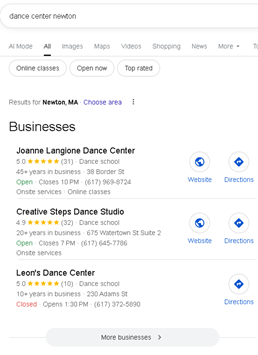
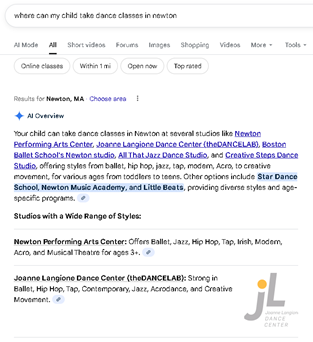
As a result of local optimization of the Joanne Langione Dance Center website, this Newton dance studio rose to the top of the Google local pack under the search term “dance center newton.” The term “where can my child take dance classes in Newton” landed JLDC in the page’s AI summary (“position zero”) for maximum local visibility.
To start, your GBP includes essential business information, including your NAP (Name, Address and Phone number).
Also, take advantage of other GBP features:
- Upload photos and videos
- Include reviews and ratings
- Add your performance schedule
- Include a Q&A section for customers
An additional path to appear in listings is having citations in local directories, online calendars and other listing sites.
Use location-based keywords strategically on your arts website
Next, local SEO for arts organizations must strategically use location-focused keywords on their websites. Doing so helps search engines identify your local area and serve up locally-focused pages to “near me” requests. For example, instead of simply using “live theatre,” try phrases like “Boston performing arts centers.” Place these phrases in your url, page titles, meta descriptions, headers and image alt text.
Create location-focused content to boost cultural arts organizations’ SEO
For successful local SEO, performing arts organizations must create content targeted to area patrons.
For example, try blog article titles like those below to build local search visibility:
- “A Top Family-Friendly Performance Experience in [Boston]”
- “The Best Theater Venues Near Me”
- “Upcoming Live Dance Events This Month in [Framingham]”
Accuracy counts. Regularly update time-specific website pages, including performance schedules, events calendars, ticketing and pricing information and any last-minute changes. Furthermore, you can create city-specific landing pages that allow you to target neighboring communities and attract audiences from surrounding areas.
Optimize for mobile and voice search
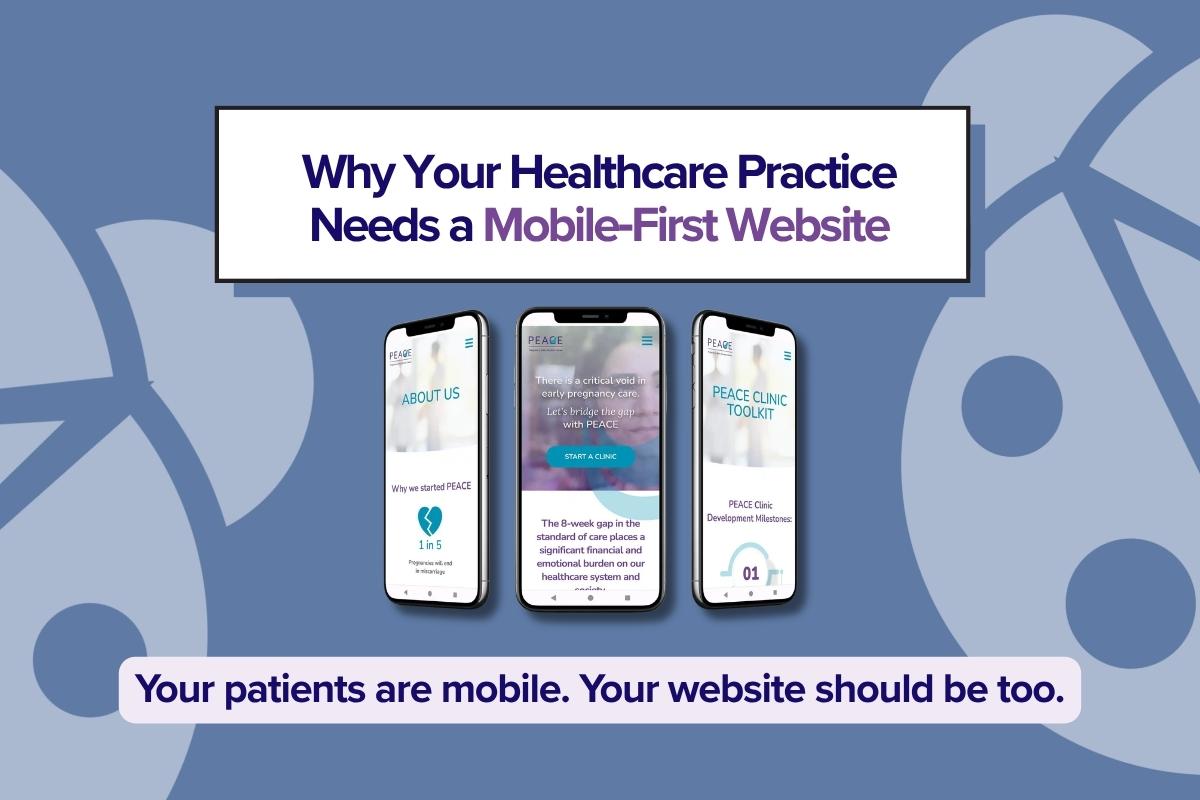
Did you know that approximately 60% of all arts ticket sales and donations occur on mobile devices? Given that, you must design your websites for all sized devices, especially smartphones. Emphasizing this point, Google uses mobile-first indexing, which prioritizes the mobile version of webpages for indexing and organic rankings.
Additionally, voice search is growing rapidly. The numbers tell the story:
- 49.6% of U.S. consumers use voice search for shopping (154.3 million Americans).
- 62% of smart speaker users plan to make a purchase using their device’s voice-enabled shopping in the next month.
- 71% of consumers prefer using voice search to manually entering queries.
Therefore, optimizing content with concise, conversational phrases like “Where can I see live theatre near me?” will improve voice results. This is a particularly valuable way to capture same-day ticket buyers.
Build local links and community mentions
High-quality backlinks from reputable local organizations are powerful signals of authority, trust, and relevance. Remember, when it comes to backlinks, quality wins out over quantity. Backlinks from partnerships with schools, museums and other cultural organizations help increase online authority. Moreover, press coverage, sponsorship mentions, and local event calendars all provide valuable local signals to search engines.

Improve local SEO for cultural arts websites with tracking and testing
Finally, long-term success requires tracking performance using relevant KPIs (Key Performance Indicators). Data analytics tools such as Google Search Console and Google Analytics help you track keyword rankings, traffic sources and user behavior. Identifying which pages generate the most ticket sales and inquiries enables you to test and adjust your content strategy over time.
Win with Local SEO for your cultural arts organization’s website
To sum up, local SEO for performing arts organizations will provide the community awareness needed to help reach your marketing goals. Solid recommendations are improving your Google Business Profile, creating location-focused content and applying local SEO strategies. In the final analysis, these techniques will provide the local visibility that your arts organization needs to thrive.
Ready to attract more local audiences to your events?
Start optimizing your arts website today and turn nearby searches into full houses for upcoming shows.