
Why accessibility is essential in women’s healthcare website design
Accessibility in women’s healthcare website design is not optional; it is a moral, ethical, and legal responsibility that directly affects patient access, safety, and trust. For many women, especially those navigating sensitive health topics like reproductive health, fertility, gynecology, pregnancy, menopause, or mental health, an inaccessible website can become a barrier to essential care.
From low-contrast text that prevents someone from reading clinic hours to forms that don’t work with assistive technology, digital barriers can create real-world consequences. For women with visual, auditory, cognitive, motor, or neurological impairments, these challenges become even more significant.
This guide explores how WCAG, ADA, HIPAA, UX principles, inclusive content, and ethical design all come together to create accessible, patient-centered digital experiences for women’s healthcare organizations.
Why accessibility matters in women’s healthcare website design
1. Website accessibility should not be optional in your women’s health website design
When you look at it this way, healthcare website accessibility for women is more than just a best practice. Instead, it’s a professional and ethical responsibility. Designing with accessibility in mind does more than improve usability—it builds trust. In other words, patients are more likely to engage with a provider or organization that presents information clearly, respects privacy, and shows inclusivity in every design element.
In accessible healthcare websites, by contrast, can unintentionally exclude patients. The reasons are not surprising. They include low-contrast text, untagged images, confusing navigation or complex medical jargon. These barriers don’t just inconvenience users; they can impact care outcomes by making it harder for individuals to find the help they need.
Best practices for healthcare website accessibility include compliance with regulations.
The first way to ensure healthcare website accessibility is to meet the guidelines that apply to all websites. This starts with following the Web Content Accessibility Guidelines (WCAG). These internationally recognized standards enable web designers to create digital experiences that are usable for everyone. In short, WCAG compliance is essential for ensuring equal access to your website.
2. The top 10 WCAG recommendations for accessibility
The Web Content Accessibility Guidelines (WCAG) outline clear, measurable criteria for inclusive web design. Below are ten recommendations for improving accessibility across any healthcare site:
- Provide text alternatives for non-text content: Add descriptive alt text to all images, icons, and media.
- Ensure sufficient color contrast: Maintain a minimum contrast ratio of 4.5:1 for standard text.
- Enable keyboard-only navigation: Users should be able to navigate and use all site features without a mouse.
- Use descriptive links and buttons: Replace vague text like Learn more with meaningful labels.
- Add captions and transcripts to multimedia Content to support users with hearing impairments.
- Maintain consistent navigation: Use predictable layouts across all pages.
- Label and validate forms clearly: Include labels, error notification, and help text for every input field.
- Avoid using color alone to convey meaning: Combine color cues with text or icons.
- Support responsive and zoom-friendly design: Content should reflow properly and remain usable at 200% zoom.
- Provide clear focus indicators: Highlight the active element when using keyboard navigation.
3. Regulatory Compliance: ADA, HIPAA, HITECH & Section 508
Next, let’s explore guidelines specific to healthcare website accessibility. These policies are in place because sensitive personal information and health-related content can impact patient care and safety. In designing your healthcare website, ensure it follows the appropriate regulations:
HIPAA: Any form or feature that handles health data must be encrypted, permission-based and compliant with HIPAA privacy and security rules
ADA (Americans with Disabilities Act): Treat ADA compliance as mandatory for any patient-facing healthcare website.
HITECH (Health Information Technology for Economic and Clinical Health) Act: Your website must have data security policies, encrypted storage and breach response procedures.
Other requirements that may be relevant to your site include:
- Section 508 (U.S. Rehabilitation Act)
- FDA Guidelines (for health apps and medical devices)
- GDPR (General Data Protection Regulation – for EU patients or traffic)
- Content accuracy and ethical standards
- Patient portal and appointment systems
- Privacy policies and consent management
In summary, these healthcare website policies cover accessibility, privacy and security, content accuracy and transparency. They represent a commitment to inclusive, ethical, and patient-centered digital care access to the health information women need.
4. Accessibility vs. Inclusivity in women’s healthcare
Accessibility ensures every woman can use your website, regardless of ability.
Inclusivity ensures every woman feels represented, respected, and safe.
Both are essential.
Accessibility = usability
Clear, compliant, functional.
Inclusivity = identity + empathy
Reflecting diverse cultural, emotional, and privacy needs. A fully accessible women’s healthcare website must do both.
5. Design best practices for accessible women’s healthcare websites
Inclusive language and imagery
Use language that is clear, respectful, and inclusive of all women and gender-diverse patients. Recognize and support patients with imagery that represents diverse ages, ethnicities, and body types.
Readable and empathetic content
Health information can be intimidating, and you want content that is easy to digest. Drop the medical jargon when possible. Write in plain language with short paragraphs, subheadings, and bulleted lists. Provide simple explanations of conditions and procedures. Convey messages with a compassionate, reassuring tone.
Accessible navigation, forms, and appointment systems
Poorly designed appointment scheduling, patient forms, and portals can be confusing in the best of circumstances and affect healthcare website accessibility. Clarity is essential. Use descriptive button labels such as Book Appointment instead of generic terms like Submit. Clearly label all elements, make them keyboard-navigable, and ensure they are compatible with assistive technologies.
Color, contrast, and font size
Maintain strong color contrast between text and background for those with visual impairment or color blindness, as well as for general readability. Choose legible fonts that are large enough for easy reading (minimum 16px) for healthcare website accessibility.
Privacy and discretion features
Women researching reproductive or mental health topics may feel uncomfortable or even unsafe without special digital privacy features. Consider adding a quick-exit or hide-this-page button, minimal data collection, and clear privacy statements.
6. Accessibility requirements unique to women’s health
Women’s health users may be navigating topics including:
- Fertility
- Pregnancy
- Sexual health
- Pelvic floor issues
- Menopause
- Mental health
- Trauma or domestic safety concerns
Because of this, your website must offer:
a. Enhanced privacy options
- Quick-exit or “hide page” buttons
- Minimal data collection
- Anonymous inquiry options
- Transparent privacy statements
b. Emotionally supportive UX
- Understanding emotional sensitivity is part of accessibility.
c. Trauma-informed design
- Avoid triggering language, imagery, or overly clinical tone.
7. UX/UI Considerations for OB/GYN, fertility & reproductive health
Different specialties require different UX approaches:
OB/GYN
- Friendly, non-judgmental tone
- Easy-to-find exam prep instructions
- Precise insurance & appointment details
Fertility Clinics
- Clear explanations of procedures
- Visual guides with alt text
- Accessible patient portals
Reproductive Health & Family Planning
- Private browsing options
- Zero-barrier appointment access
- Non-stigmatizing language
8. Culturally competent & trauma-informed design
To create a culturally accessible website:
- Show diverse races, ages, body types, and family structures
- Provide translation or multilingual content for local demographics
- Acknowledge cultural differences in healthcare experiences
- Use inclusive language: “women and gender-diverse patients”
- Accessibility extends beyond disabilities—culture and context matter.
9. Mobile-first design for women’s digital care journey
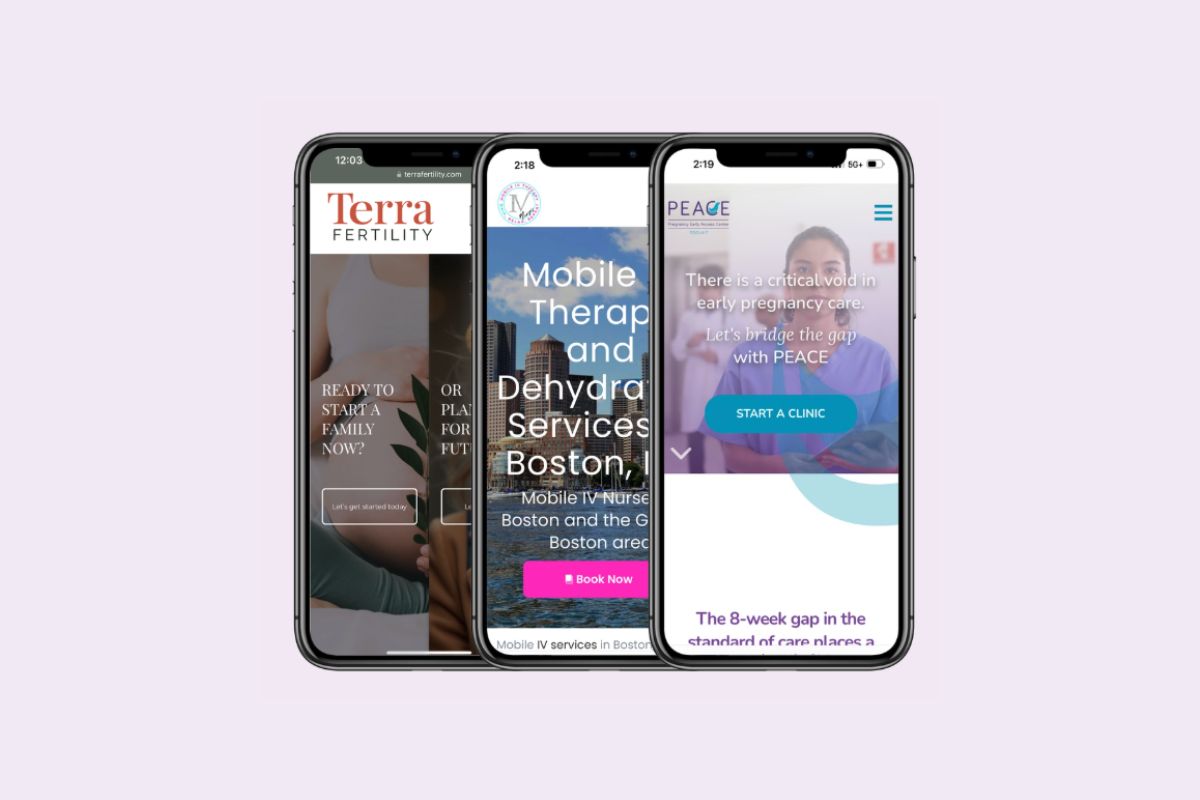
Women frequently use mobile devices and apps to search for healthcare information. Ensure layouts are responsive so they display and function correctly on small screens. Simplify navigation, ensure readable text, and provide thumb-friendly interactive elements, such as buttons and calls to action (CTAs).
10. Accessible multimedia for women’s health education
Include captions and transcripts for all educational videos or podcasts. Visual guides about pregnancy, fertility, or wellness should include alt text and descriptions for users with visual impairments and healthcare website accessibility.
11. Key UX Differences: How accessibility differs for women’s vs. men’s healthcare
While accessibility principles apply universally, there are subtle but essential differences in how women’s and men’s healthcare sites should approach design and communication. The chart below addresses key differences.
Content focus for designing an accessible healthcare website
| Element | Women | Men |
|---|---|---|
| Content Focus | Broader scope including reproductive, hormonal, and emotional health. | More focused on specific medical conditions with less variation. |
| Privacy Needs | High privacy needs for contraception, pregnancy, and domestic safety. | Generally moderate privacy needs. |
| Tone | Compassionate, supportive tone that builds trust. | Informational, direct tone. |
| Lifecycle Perspective | Addresses changing needs from adolescence to menopause. | Lifecycle needs are more stable with fewer variations. |
| Design Emphasis | Inclusive, empathetic design that creates emotional connection. | Clear, efficient, straightforward design. |
Understanding these differences ensures accessibility efforts feel authentic and tailored to your audience, rather than generic.
Healthcare website accessibility is the heart of digital care for all women
When looking at the digital representation of your organization, use healthcare web accessibility as a guiding principle. Among the most critical aspects are intuitive functionality, an empathic tone, and complying with industry guidelines. Build your website to support every patient’s right to their healthcare information. This means ensuring that every woman, regardless of ability or circumstance, can access the care she deserves.
Your website accessibility shouldn’t be an afterthought; it should be built in.
If you are ready to create or improve an accessible women’s healthcare website, partner with Ladybugz Interactive, the award-winning agency specializing in inclusive, accessible healthcare design.