Why Public Biotech Website Design Is Different
Unlike a privately held early-stage biotech company, every word on a public biotech website matters. Important information such as dates, pipeline status, and clinical milestones is more relevant and even necessary now than it was before the company went public. Legal obligations and compliance also add new requirements.
The website is no longer just a landing page to attract investment or explain science; it serves more purposes and must speak to more audiences. The website must meet investor expectations, show scientific credibility with resources and papers, provide public-facing company communications, and present constantly changing clinical and corporate information.
A Public Biotech Website Has Different Responsibilities
Once a biotech company goes from private to publicly traded, its website takes on more responsibilities to a broader audience. It is no longer just a marketing tool.
A public biotech website must serve key investors, analysts, scientists, potential partners, media, board members, and regulators. It must also continue to communicate complex science alongside an evolving story.
NervGen: Making a Complex Pipeline Easier to Explore
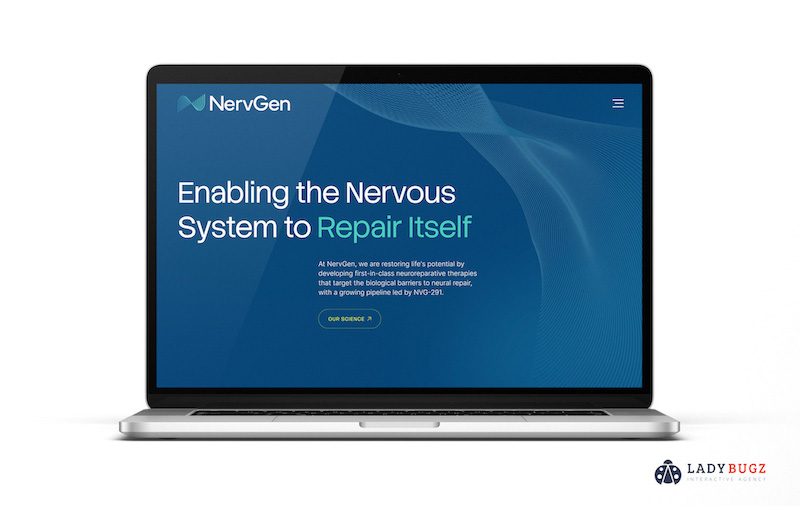
NervGen, a public clinical-stage biotech with multiple programs and indications, came to us for a website redesign. The company needed to uplevel its brand while prioritizing its lead program, but also make its other indications easy to find.
Our team simplified the initial pipeline view and used interactive elements to provide additional information without overwhelming the user on the page. With improved UX, we created clearer paths to dive deeper into science and program information. NervGen is a notable example of how interaction can serve a functional purpose, not just add visual appeal.
Last, our development team made the pipeline and overall website easy to manage and update as the company progresses.
Explore NervGen’s Website
The Website Has to Tell Your Current Investor Story, Quickly
Early-stage public biotechs change incredibly fast. Their programs advance, fail, pause, get deprioritized, or move back into preclinical development. Companies raise capital, change leadership, narrow their focus, expand indications, and prepare for commercialization.
The website can’t continue telling last year’s story. The homepage should answer the questions investors typically want to know.
For example:
- What does this company do?
- What is its lead program?
- What problem is it solving?
- Where is the program clinically?
- Why does the science matter?
- What should I explore next?

Complex Science Has to Work for Scientists AND Investors
Public biotech companies must explain complicated scientific concepts not just to one or two audiences, but to several, including investors, scientists, physicians, patients, partners, and media.
Simplify The Science
Your science page and science sections of your biotech website should start with the bigger scientific story. Once you set that theme, you can give users different paths to explore more extensive information. Some users might just want the overall picture story, while others, such as scientists or investors, may want to dig deeper into it.
In our experience, clients in this space use visual presentations to explain and demonstrate difficult concepts. Examples include MOA (Mechanism of Action) graphics, scientific illustrations, diagrams, and animations, and even videos that explain things more visually.
Some examples could include:
- A diagram showing how a drug interacts with its target
- An illustration showing how a T-cell therapy recognizes and attacks cancer cells
- An animation showing a therapy moving through a biological pathway
- A step-by-step graphic explaining how a company’s platform produces a therapeutic effect
All of these examples are much easier to understand than several paragraphs of scientific text.

Connect the Science to the Pipeline
On the science page, connect the visuals and messaging to show how the technology or drug could or is translating into new therapies for the patients. For example, place a visual on one side of the page, with information next to it about the platform and what it means for drugs or therapies, what condition it treats, and how it is different from other treatments. End by highlighting how this science can benefit patients overall. This is a great opportunity to create pathways that guide users through the website and encourage them to learn more about the pipeline.
Keep your science page clean and concise. Stay focused on the main scientific story and put more detailed information, such as scientific data, publications, and posters, into a resources or news section.
Scientific imagery can be tricky to create. Designing scientific animations and illustrations is a detail-oriented skill that requires working directly with scientists or company leaders close to the science. With public biotech companies, scientific visuals should always be reviewed for accuracy and signed off on by leadership. The goal of the visuals is to make the science easier to understand, not change or skew it.
The Pipeline Design Is One of the Most Important Pieces of a Public Biotech Website
Like privately held biotechs, public biotech companies also need a clearly communicated pipeline.
To build interest, the pipeline needs to be scannable, allowing investors and investigators to quickly see the program(s), indications, lead assets, partnerships, and other key milestones.
Use Design and Color
Labels, spacing, color, and visual hierarchy help make programs distinguishable and visually appealing without overcrowding the pipeline. Avoid putting every scientific detail in the pipeline; use internal links, buttons, or other graphics to guide users to the science, clinical trial, or publications for deeper details.
Be Scientifically Accurate
Scientific accuracy and usability must work together in the pipeline. Poor design choices can accidentally make a program appear further along than it is. The pipeline should simplify the presentation, not the science behind it. In most cases, senior leadership and legal will review the pipeline for accuracy.
For Multiple Indications and Stages
Show multiple indications at different stages, and distinguish anticipated from completed milestones.
Create for Future Growth
One thing you can count on is early-stage biotech growth. Make sure the pipeline is easy to update later. Using native website technology is better than creating custom graphics.
Make it Mobile
Make sure the pipeline displays accurately on mobile. Don’t make the mistake of a shrunken version of the desktop graphic.
The Corporate Website and Investor Relations Portal Need to Work Together
For the most part, public biotech websites use an external IR platform/provider to handle the SEC regulatory parts of the website.
Typically, an IR platform hosts some or all of the following pages:
- SEC filings
- Stock information
- Press releases
- Presentations
- Governance
- Automated feeds
To make the experience as seamless as possible, the design template is handed off to the IR provider to build out. When working with an IR provider, bring them in early because their implementation timeline may be four to six weeks.
You will also want to test the IR pages on the website to make sure everything works as planned. Some issues could include formatting problems or duplicate information. It should be clear to the biotech company who is responsible for which parts of the project to avoid confusion or glitches before launch.
Public Company Websites Require a Different Content Review Process
Your public company website is no longer just a marketing tool. It confirms clinical programs, partnerships, milestones, and company progress. The website must be accurate and consistent with what the company publicly discloses.
Be careful when presenting clinical progress and milestones. Distinguish anticipated events from completed ones.
Pipeline graphics and scientific claims must accurately reflect development status and shouldn’t unintentionally imply progress, results, or partnerships that haven’t happened yet.
Build time into your process for corporate communications, investor relations, scientific leadership, and legal/compliance to review the website as needed.
For a public biotech company, even a small change or wording mistake in visual design can affect how investors interpret the company’s progress. That is why accuracy and a strong review process matter.
Build a Website That Can Evolve as Fast As The Company
An early-stage public biotech company is just that, so expect frequent website changes. The most common changes will likely involve the pipeline, clinical data, leadership, financing, new indications, publications, or shifts in the corporate story.
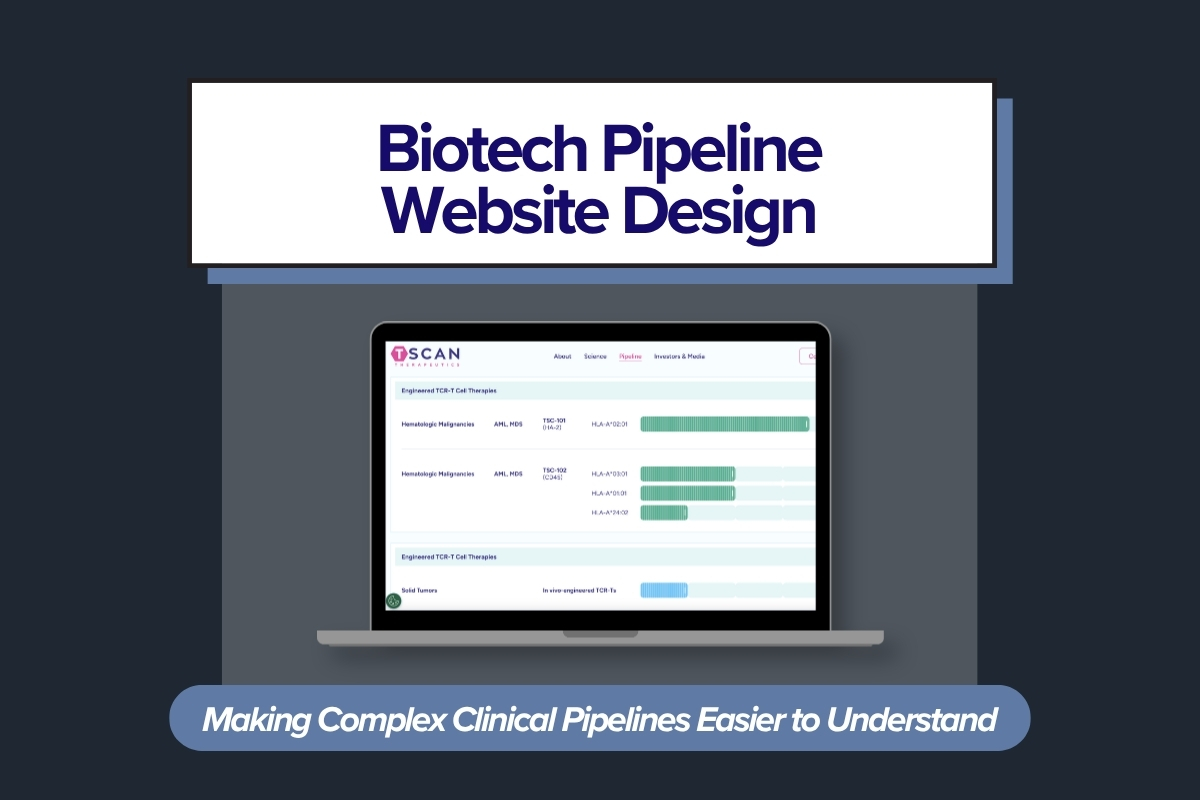
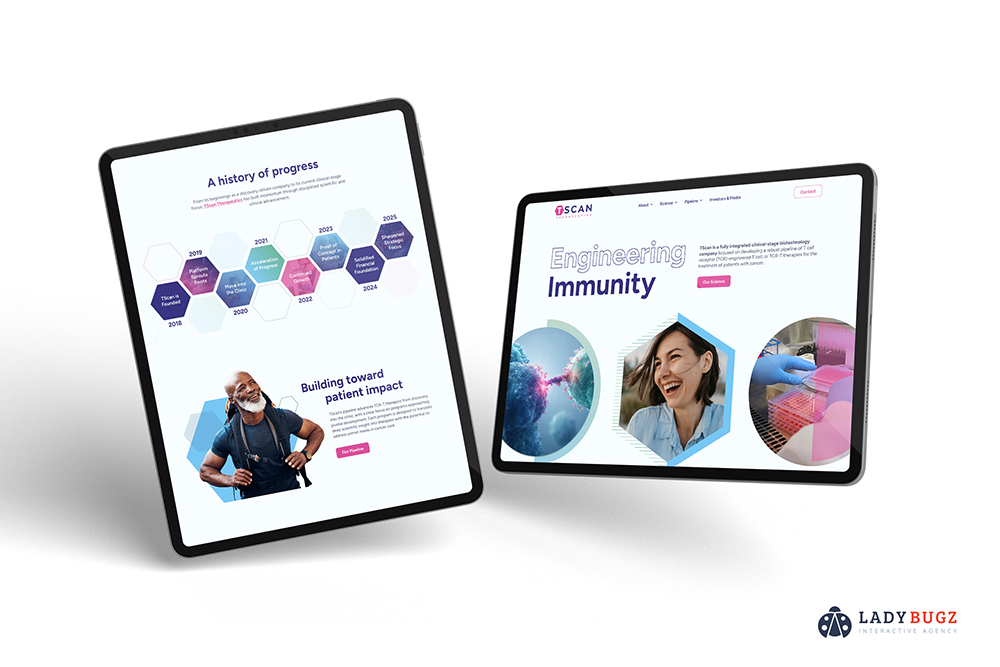
In our recent project for TScan Therapeutics, the corporate story changed substantially, and the company wanted the new website to reflect its new focus.
At Ladybugz, we build all of our websites with evolution in mind. We make them easy to update and can also serve as your partner for a seamless update experience when needed.
We want your website to grow with you.
Public Biotech Website Spotlight: TScan Therapeutics
Clinical-stage storytelling and Pipeline Design
TScan Therapeutics, a public clinical-stage biotech company with multiple programs and indications, needed a website to reflect its corporate story and advanced stage of growth.
The Ladybugz team created a website that simplified the pipeline and clarified the company’s clinical progress. With smart design and visual storytelling, we connected the science to programs and patient impact. Lastly, we built the website with scale in mind, so it can easily evolve as programs advance.
Explore TScan’s Website
Don’t Forget Mobile, Accessibility, Privacy, SEO, and AI Search
Modern websites need to be mobile-friendly or even mobile-first. It’s not only a better user experience, but it also positively impacts your SEO and AI-driven searches.
Accessibility is no longer an afterthought; the website needs to comply with the Americans with Disabilities Act. In 2026 and beyond, it’s standard practice to build websites with accessibility in mind and meet benchmark guidelines. Typically at Ladybugz, when we design public biotech company websites, we don’t use third-party software for accessibility; we strive for AA compliance.
And lastly, you’ll need to be in compliance with privacy laws, which an experienced biotech web design company will know and help you implement these legalities. At Ladybugz, after careful research and testing several implementations, we chose “Cookiebot” as our privacy partner, and their flexible software has successfully met our clients’ needs.
What Pages Should a Public Biotech Website Include?
We review this question with every project we take on. The pages on a public biotech website can vary slightly, but here is the most common list we typically see:
- Homepage
- Science/platform
- Pipeline
- Programs
- Publications
- News
- Investors
- Leadership/Board
- Governance
- Careers
- Contact,
- Privacy/legal
Websites vary, and you may want extra pages tailored to your biotech company.
Choosing a Website Partner That Understands Public Biotech
When choosing the best web design agency for public biotech companies, consider several factors.
One of the most important qualities is to hire an agency with vetted experience and reviews in your space. You want someone who has worked with a public biotech company in its early stages.
Work with a collaborative partner that understands your needs as a company when it comes to explaining science, is visually creative, and can provide storytelling as your strategic goals change.
Most agencies with a track record in biotech should show examples of custom-designed pipelines, scalable back-end systems, and experience working with IR providers.
Growing public biotechs need an agency that is agile, collaborative, and can help make smart decisions and respond quickly to changing needs.
A Communications and Marketing Tool For All Audiences
Your public early-stage biotech website isn’t just telling your story; it is supporting your investor communications, explaining your complex science, presenting your pipeline, establishing credibility, and evolving alongside the company as it grows. Knowing what you need and hiring the right experienced partner is crucial to your website’s success.